Tuesday, March 8, 2011

How to Build an Arthropod (An Arthropod Leg, at Least)

Liu J, Steiner M, Dunlop JA, Keupp H, Shu D, Ou Q, Han J, Zhang Z, & Zhang X. (2011) An armoured Cambrian lobopodian from China with arthropod-like appendages. Nature, 470(7335), 526-30. 

ResearchBlogging.org


If you’ve ever wondered what a “typical” animal looks like, here it is:
Beetles are the largest group of animals in the world, constituting 400,000 species, or about 40% of all known animals on earth.  Beetles and other insects are part of the phylum Arthropoda, which encompasses animals that have an exoskeleton and jointed appendages.  Besides the insects, crabs, spiders, centipedes, scorpions, and the extinct trilobites are also arthropods.  Together, arthropods account for 80% of all known animals.

Genetic evidence suggests that the closest living relatives of arthropods are the Onycophorans, or velvet worms.  These animals show segmentation like the arthropods, but they lack rigid bodies or limbs.  Interestingly, the specialized, jointed appendages of arthropods seems to have been critical to their evolutionary success; although over a million species of arthropods are known, only about 70 living species of onycohporans have been described (Pechenik 2010).

Recently, a team of paleontologists from China and Germany published some exceptionally preserved Cambrian fossils that show a possible link between the onycohporan and arthropod bodyplans.  The animal, called Diania cactiformis, has a soft body like an onycohporan, but hardened, jointed limbs like arthropods.  Below is an image of one of the fossils from the publication, as well as a reconstruction of what the animal may have looked like:
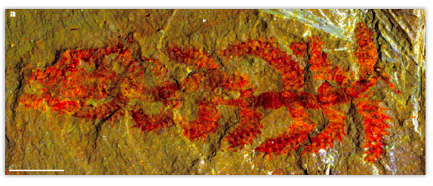

Diania is not the first fossil animal to bridge the gap between onycohporans and arthropods.  During the Cambrian, a number of animals generically lumped together as lobopods evolved, which had soft, worm-like bodies with varying degrees of armor on their shoulders and legs (including Hallucigenia, which wins my nomination for greatest animal name in history).  But Diania shows more characteristics in common with true arthropods than any previously described lobopod. 

The authors of this paper are hesitant to say that this conclusively shows that hardened arthropod limbs evolved before hardened arthropod bodies, or speculate on why complex, hardened limbs might have evolved first.  Whatever the case, Diania is an incredible example that “missing links” in the fossil record do not typically look like a perfectly intermediate blend of two animals.  Instead they often have an unexpected mosaic of features, and show unique adaptations suited to their distinct environments.

Works Cited 

Liu J, Steiner M, Dunlop JA, Keupp H, Shu D, Ou Q, Han J, Zhang Z, & Zhang X (2011). An armoured Cambrian lobopodian from China with arthropod-like appendages. Nature, 470 (7335), 526-30 PMID: 21350485


Pechenik, J. A. (2010). Biology of the Invertebrates (Sixth Edition). New York: McGraw-Hill Higher Education.

Thursday, February 17, 2011

A Bio-Blueprints Primer: Paraphyly and Last Common Ancestors

There are a couple of papers that I want to discuss soon that involve the topic of paraphyly.  Instead of trying to cram background and a paper review into one post, I am trying a new method, where I present a quick primer of a concept that can be referred back to in later posts. Perhaps that will make this post none too interesting, but I hope it will be useful in the future.

It’s hard not to call the jellyfish that I study “primitive”.  Certainly jellyfish are much simpler than most animals; they lack organs, a central nervous system, or a middle layer of cells.  Living jellyfish also look similar to ones in the fossil record, so it is probably fair to say they haven’t changed much during the course of evolution.  However, the reason I try to stop myself from calling them “primitive” is that it gives the false impression that our ancestors looked like a jellyfish. 

For example, let’s take a simple evolutionary tree (or phylogeny), showing the relationship between a jellyfish and a human, and ask ourselves what the common ancestor of these two animals looked like:
Given the information I presented about jellyfish, you might think that the last common ancestor looked like the simple jellyfish.  However, both the jellyfish and the human have been evolving for an equal amount of time, so the last common ancestor of the two animals might look nothing like either species:
But let’s say we add a second species of jellyfish to our phylogeny, and we get this result:
 
In this scenario, some jellyfish are more closely related to humans than they are to other jellyfish.  This means the last common ancestor of the creatures we call “jellyfish” would also include the ancestor of human beings.  If this tree were correct, scientists would say that “jellyfish” are a paraphyletic group, meaning that you cannot capture the last common ancestor of jellyfish without also including other animals that we would not normally call jellyfish.

The nice thing about paraphyletic groups is that they give you a much better idea of what the last common ancestor looked like.  In my jellyfish example, the last common ancestor of these three animals either looked like a jellyfish, or both “jellyfish” lineages independently evolved all of the characteristics that jellyfish have in common (which is unlikely).

There is no scientific evidence that the phylogeny I presented is true.  It was just an example of the principle.  However, one example of a paraphyletic group that scientists do think is real is the “reptiles”:
For a long time, some scientists have argued that crocodiles are more closely related to birds then they are to other reptiles (lizards, snakes, or turtles).   This is because fossil evidence suggests that crocodiles are evolutionary cousins of the dinosaurs, and birds evolved from dinosaurs.  DNA evidence supports this hypothesis, meaning that the term “reptile” is paraphyletic.

This phylogeny provides good evidence that the last ancestor of birds and crocodiles probably was cold-blooded, and had four legs, scaly skin, and a tail.  Of course, if we only looked at living animals, we would have no idea of the bizarre creatures that connect the two lineages, which is why paleontology is so important:

In coming posts, I will discuss the growing body of genetic evidence that suggests that many groups of animals are paraphyletic, and how this provides a better understanding of the direction of evolutionary change.

Saturday, February 12, 2011

How Aliens Are Going to Cure Cancer


ResearchBlogging.org


One of my friends recently asked me what an astrobiology publication is like.  As a member of the NASA-funded Advent of Complex Life astrobiology team, I feel like I should be able to answer that. 

Given that there is no actual alien biology to study (yet), I have often considered the field as more of a think-tank, where scientists from all disciplines get together and discuss what it takes for life to evolve, what that life would be like, and how to detect it.  I would say that most of the researchers I know in astrobiology wouldn’t call themselves astrobiologists first and foremost; instead they are “geochemists” or “geneticists” whose work has consequence for astrobiological questions.

However, a paper just came out in the journal Physical Biology from two thinkers that I would definitely consider astrobiologists, Paul Davies and Charles Lineweaver.  Paul Davies is one of those big-thinkers who, at least in his popular writings, likes to play with philosophy as much as science.  When I was a high-school student I read one of his books, “The Last Three Minutes”, which was an enjoyable review of the different ways astronomers think the universe will end, and how humanity could survive these scenarios.  I have met Charles Lineweaver at several astrobiology conventions, and he has always been a unique thinker and a highly engaging guy to talk to.

In this paper, Davies and Lineweaver discuss the implications of thinking about cancer in an ancient evolutionary context.  In the current paradigm, cancerous cells are often considered “rouge agents” that, through mutations, loose their ability to communicate with other cells. Without the proper means to talk to the rest of the body, these cells reproduce uncontrolled.  In Davies’ and Lineweaver’s paradigm, these mutations actually cause the cell to revert back to an ancient cell-state, before animals became highly specialized, multicellular organisms. This is a type of atavism, where a mutation causes an ancestral state to be “turned on” again in a living organism. For example, humans are sometimes born with tails, horses with extra toes, and whales with hind legs (check out Gould 1980 for an popular-science account of atavisms).  In this paradigm, cancer cells are a reversion to a primitive ancestor of metazoans (scientific jargon for animals), so Davies and Lineweaver call cancer “Metazoa 1.0”.  Usually, the gene pathways that lead to cancerous “Metazoa 1.0” are controlled by more evolutionarily advanced gene pathways.  But if a mutation causes the normal gene networks to fail, the cell defaults to an robust, ancient gene network, creating a dangerous cancer cell.

What I really like about this work is that Davies and Lineweaver cover all of the proper bases when suggesting a scientific paradigm shift: (1) they show how their theory explains more of the data than the previous theory (2) they offer testable hypotheses their paradigm predicts, and (3) they show how their paradigm has novel consequences for the field.  I’ll quickly mention some of the main points they cover from each of these topics.

(1) Cancer as Metazoa 1.0 – Better Explanation of Data

Cancer cells are surprisingly well-coordinated and well-defended for cells that are the results of mutation.  Davies and Lineweaver note that cancerous tumors sometimes work together for the good of the group, such as when tumors build their own blood supplies (a process called angiogenesis). Cancer cells also have a whole battery of defenses that they commonly use to defend themselves against the body, including the ability to silence cancer-suppression genes, avoid detection by removing their own surface-receptor proteins, and secreting corrosive enzymes to move freely between tissues (Davies and Lineweaver offer a much more comprehensive list).  In the “rouge cell” paradigm, cancer cells gain these advantages through cellular Darwinism, where only the most sophisticated cancer cells are able to avoid the body’s defenses and reproduce through the body.  But Davies and Lineweaver argue that these complex behaviors seem too universal and too common to be the result of selection at the cellular level.  The vast majority of mutations that make cells go cancerous should lead to failure, but instead most cancers utilize all of these complex defenses.  This makes more sense if you think of cancers as a reversion to an ancestral, semi-multicellular cell-type that coordinates with similar cells and has a host of natural defenses that evolved long-ago. 

(2) Cancer as Metazoa 1.0 – Novel Hypotheses

If your new theory cannot be distinguished a priori from the previous theory, then your new hypothesis is not scientific (a point I plan to pursue in future posts).  Davies and Lineweaver offer several hypotheses that they predict from their theory.  For example, they suggest that if we study the order in which a cancerous cell develops traits, there should be broad patterns in the development of different cancer types.  If cancer cells are reverting to the same ancient genetic toolkit, we might expect cancer cells to first exhibit one trait (such as switching on membrane-dissolving proteins) followed by a second trait (such as activating genes that allow for cancer proliferation).  If cancers are simply randomly generated rouge cells, they are just as likely to display any, all, or none of these traits at any given stage in their development. 

(3) Cancer as Metazoa 1.0 – New Promises

In the “rouge cell” theory of cancer, there are as many ways for cancer to develop as there are ways for genetic mutations to mess up a cell (which is more or less infinite).   This would make President Obama’s pledge to find for a “cure for cancer” during our lifetime, or any lifetime, an impossible dream.  But if most serious types of cancer are the result of a reversion to an ancestral toolkit of genes, then there would be a unifying principle to cancer.  This would allow scientists to focus on pathways critical to “Metazoa 1.0”, which could lead to broad, gene-based cancer therapies. 

I highly recommend checking the paper out yourself; it is an easy and interesting read for scientists and non-scientists alike*. If you read Davies’ and Lineweaver’s press release, they consider this work a direct application of astrobiology research.

And now you know how the search for alien life will cure cancer.

*If you are not affiliated with a University, you might have a hard time accessing the paper, if you want a PDF copy let me know and I’ll send it to you.

Works Cited

Davies PC, & Lineweaver CH (2011). Cancer tumors as Metazoa 1.0: tapping genes of ancient ancestors. Physical biology, 8 (1) PMID: 21301065


Gould, S. J. (1983). Hen's teeth and horse's toes: Further reflections in natural history. New York: Norton.


Tuesday, February 8, 2011

The Messiness of Development Part 1: incomplete penetrance

ResearchBlogging.org
There is a great degree of robustness in development.  Without fail, the majority of embryos are capable of growing from a single-celled egg into a functional adult comprised of billions of interacting cells.  How this happens is the holy grail of developmental biology, and is a major field of study in science. But development can be an extremely sloppy process as well, a phenomenon known as developmental stochasticity. Molecules randomly bounce around and between cells, genes regulate other genes with varying degrees of effectiveness, and cells constantly migrate around the developing body.  The huge numbers of developmental defects attest to how easy it is for this process to screw up.  Although the concept of developmental stochasticity has been around since the early 1900’s, it is only recently that scientists have had the genetic tools to consider this phenomenon in real functional detail.
Andrew Oates at the Max Planck Institute of Molecular Cell Biology and Genetics in Dresden, Germany, just published a very interesting review of developmental stochasticity in the journal Development.  Because it covers so many ideas, I thought I would break the paper down into its parts, and address each theme independently.
The first idea is known as incomplete penetrance. Perhaps it isn’t the best name for a phenomenon, but it gets the point across: incomplete penetrance is when the same mutation has different effects on individuals in a population.  For example, while a genetic mutation might give one animal dark fur, the same mutation might have no effect on another member of the species.
Oates focused on recent progress on the genetics behind incomplete penetration from Alexander van Oudenaarden’s group at MIT, which studies the nematode worm Ceanorhabditis elegans:

 One of the reasons this worm has become a model organism in developmental biology is that it has invariant development, meaning each cell is pre-programmed to differentiate into its final cell-type (mammal cells, on the other hand, usually need chemical cues from surrounding cells to know what type of cell to ultimately become).  You might think that since C. elegans development is so deterministic, there wouldn’t be much room for mutation-caused variability, but in a Nature paper published by Raj et al. (2010), van Oudenaarden's team discovered how incomplete penetrance affects development of the worm’s intestine.
In normal (wild-type) worms, the gene skn-1 regulates the formation of the intestine. Below is the skn-1 gene network in C. elegans. If you’re unfamiliar with gene networks, the arrows show you the direction of genetic control. For example, skn-1 has arrows pointng from it to three other genes (end-1, end-3 and med-1/2), meaning that the gene skn-1 regulates the expression of these genes (you could also say that skn-1 is upstream of these genes). elt-2 is downstream of end-3 and end-1, and the gene also regulates itself (hence the circular arrow).  This means the protein product of elt-2 encourages the production of more elt-2.
Normally,  skn-1 mutants are unable to complete this gene network, so they fail to develop a proper intestine.  However, this is not always the case.  Sometimes,  skn-1 mutants had no intestine, but other times skn-1 mutants did.  Below is an image of developing C. elegans worms; on the right are normal embryos expressing elt-2 (labeled pink) in the developing intestine.  On the left are skn-1 mutants; although they all have the same mutation, some still show elt-2 expression:

This led to the discovery that most of the mutations created in skn-1 still allowed for the regulation of the gene end-1end-1 shows stochastic expression; if enough the end-1 protein product is created that the gene crosses a threshold, then it can turn the gene elt-2 on, even without the rest of the gene network:

At least four cells are needed to express end-1 to generate proper expression of elt-2.  This is a great example of how development can be robust against mutation, and how chance fluctuations in gene product can cause the same mutation to have different effects. 
Works Cited


Oates AC (2011). What's all the noise about developmental stochasticity? Development (Cambridge, England), 138 (4), 601-7 PMID: 21266404


Raj A, Rifkin SA, Andersen E, & van Oudenaarden A (2010). Variability in gene expression underlies incomplete penetrance. Nature, 463 (7283), 913-8 PMID: 20164922

Thursday, February 3, 2011

Is A Cloned Mammoth Half a Decade Away?

ResearchBlogging.org
The concept of cloning an extinct animal is no longer considered science fiction in the scientific community, but the problems associated with accomplishing this task seem to only increase with our understanding of development. One of the real problems with cloning an extinct creature isn’t just getting the DNA, but having a proper surrogate for the embryos development. As recent advances in genomics have made clear, shoving DNA into a cell is unlikely to accomplish much of anything.  The genome has to interact with a number of maternal genes (genes released by the mother) as well as regulatory networks that are initiated during fertilization.  So even if you had the DNA of an extinct animal, you probably need a close relative to act a surrogate and provide the appropriate genetic regulation.

This bodes poorly for dinosaurs, which never had much of a chance to begin with since DNA doesn’t seem to survive past a few hundred thousand years, even in the best conditions.  DNA has been recovered from prehistoric animals like saber-toothed cats and giant sloths, as well as recently extinct animals such as the Tasmanian wolf, but these animals have no close relatives alive today.  Other prehistoric animals, such as extinct bison or horses, or the massive auroch cows, do have close relatives and may be feasible to clone (they may very well be the first extinct animals cloned), but aren’t quite as exciting as a dinosaur.  Neanderthals have a genome and a close relative, but that opens up a whole can of ethical issues…


This is why my money is on the wooly mammoth


The mammoth genome has already been sequenced, and it is clearly a very close relative to living elephants.  In fact, it appears more closely related to Asian elephants than living African elephants are.  In theory, one could synthetically reconstruct the entire genome of the mammoth, stick it into an egg, and place the egg into a female elephant.  Unfortunately, while last year did mark the creation of the first synthetic life-form (Gibson et al. 2010), that was a simplified bacteria with a little over 1 million DNA base pairs in its genome.  The mammoth, by contrast, has 3-4 billion base pairs, making a synthetic genome too costly, at least for now…

Instead of synthetically engineering a genome, the other possibility would be to get good eggs and/or sperm from a frozen mammoth.  Several research teams have been trying this for over a decade, but in news articles covered by CNN and the Japanese Daily Yomiuri, scientists collaborating from Japan, Russia, and the US report the collection of promising tissues last summer.  There are large numbers of them frozen across northern Europe, Asia, and North America, and with the warming trends in the arctic, more and more mammoths are being discovered every year.  They also have perfected a technique to extract nuclei from frozen eggs without damaging them.

According to these news articles, the team is hoping to have it done in five to six years. I have a $20 bet riding on the cloning of a mammoth within the next ten years.  Here’s hoping.


Works Cited:

Gibson DG, Glass JI, Lartigue C, Noskov VN, Chuang RY, Algire MA, Benders GA, Montague MG, Ma L, Moodie MM, Merryman C, Vashee S, Krishnakumar R, Assad-Garcia N, Andrews-Pfannkoch C, Denisova EA, Young L, Qi ZQ, Segall-Shapiro TH, Calvey CH, Parmar PP, Hutchison CA 3rd, Smith HO, & Venter JC (2010). Creation of a bacterial cell controlled by a chemically synthesized genome. Science (New York, N.Y.), 329 (5987), 52-6 PMID: 20488990

Friday, January 21, 2011

The Prehistoric Oceans Are Upon Us

ResearchBlogging.org
P. Licandro, D. V. P. Conway, M. N. Daly Yahia, M. L. Fernandez de Puelles, S. Gasparini, J. H. Hecq, P. Tranter, R. R. Kirby. A blooming jellyfish in the northeast Atlantic and Mediterranean. Biology Letters, 2010; 6 (5): 688 DOI: 10.1098/rsbl.2010.0150


This paper doesn’t quite fall under the evolution/development/paleontology tent, but as a jellyfish researcher, I can’t resist mentioning some of the more interesting (and sometimes disturbing) work coming out on these animals. It was a mere 600 million years ago when jellyfish were one of the only creatures swimming in the oceans, and some ecologists have worried if that is going to happen again. With the collapse of multiple fish stocks, as well as a warming and increasingly oxygen-poor ocean, the environment seems right for jellyfish to thrive. There have been a number of reports of large jellyfish blooms over the last decade, occasionally causing serious damage to farm-fishing industries and tourism (Purcell 2007, Doyle 2008). However, it is also known that jellyfish blooms are cyclical, so it is sometimes difficult to determine if large swarms of jellyfish are unusual or a natural phenomenon.


In a new recent paper published in Biology Letters, Licandro et al. try to get a hand on the problem using data from the Continuous Plankton Recorder. This instrument has been attached to ships and towed through the oceans since 1931, providing rough data on the abundance of plankton in the ocean. By looking for jellyfish tissue and nematocysts (stinging cells), they were able to see how the frequency of jellyfish has changed since 1958. Below is a chart showing jellyfish numbers (higher frequency = red) throughout the months (on the y axis) of each year (on the x axis). For example, in 1970 there was no evidence of jellyfish until about April, and they disappeared after July without ever reaching a high concentration:


This graph suggests that the jellyfish now persist throughout the year in the Northeast Atlantic, and they exist in higher numbers than usual. Licandro et al. think the cause might have to do with the warming of the oceans over the last decade. To the left is a map showing the change in jellyfish numbers, to the right is the change in the sea surface temperature (differences were measured as the mean differences between 1958–2001 and 2002–2007):


While the methods for using the Continuous Plankton Recorder haven’t changed since 1948, the methods use to analyze the data have. In the past, it would have been difficult, if not impossible to tell what types of jellyfish these nematocytes came from. With DNA testing Licandro et al. determined that the prime culprit is Pelagia noctiluca:


This is the same species that formed a 10-mile bloom of the coast of Ireland in 2007 and destroyed a 100,000 fish salmon farm! Unlike the jellyfish I study (the moon jelly Aurelia aurita), these animals can give humans a nasty sting, so an increase of these in the oceans isn’t something to look forward to.


This paper offers quantitative support to an idea that many scientists have grown concerned about, that changing ocean conditions are positively affecting the abundance of jellyfish to the detriment of other swimming sea creatures. It’s a worrisome idea if you care about seafood or biodiversity, but it’s not so bad if you study jellyfish…


References

Doyle, T., De Haas, H., Cotton, D., Dorschel, B., Cummins, V., Houghton, J., Davenport, J., & Hays, G. (2008). Widespread occurrence of the jellyfish Pelagia noctiluca in Irish coastal and shelf waters Journal of Plankton Research, 30 (8), 963-968 DOI: 10.1093/plankt/fbn052

Licandro, P., Conway, D., Daly Yahia, M., Fernandez de Puelles, M., Gasparini, S., Hecq, J., Tranter, P., & Kirby, R. (2010). A blooming jellyfish in the northeast Atlantic and Mediterranean Biology Letters, 6 (5), 688-691 DOI: 10.1098/rsbl.2010.0150

Purcell, J., Uye, S., & Lo, W. (2007). Anthropogenic causes of jellyfish blooms and their direct consequences for humans: a review Marine Ecology Progress Series, 350, 153-174 DOI: 10.3354/meps07093